Manufacturing Institute Takes on Second Chance Hiring
Get the Latest News
Sign up here
The Manufacturing Institute—the workforce development and education partner of the NAM—is partnering with the Charles Koch Institute to expand second chance hiring opportunities in the manufacturing industry.
What is second chance hiring? One in three Americans possess a criminal record. Without being offered a “second chance” at a stable job, many in this sizable talent pool are excluded from the workforce.
Why it matters: The manufacturing industry has more than half a million jobs open right now and will need to fill 4 million over the next decade. Second chance programs not only increase equal opportunity and diversity in the industry but are also a key tool for building manufacturing’s future workforce.
What we’re doing about it: The MI’s initiative, funded by a grant from the Charles Koch Institute, will offer resources and expertise to help employers make the best use of second chance hiring. These resources will include roundtable discussions and webinars, C-suite leadership events, case studies, a pilot program and original research for the manufacturing industry.
The MI says: “Second chance hiring gives businesses an opportunity to welcome highly motivated, engaged, productive and loyal new team members that may otherwise be overlooked,” said MI Executive Director Carolyn Lee. “This is not only the right thing to do for our businesses, but it’s also the right thing to strengthen our communities.”
- “This partnership enables the MI to educate manufacturers in America on second chance hiring best practices and help them utilize second chance hiring as a strategy to fill open jobs. This effort will also expand our Diversity and Inclusion initiative that’s critical to the future health and success of the industry.”
A real-world example: Nehemiah Manufacturing Co., a consumer-product manufacturer in Cincinnati, has a workforce of about 180 employees—about 80% of whom have criminal records, according to The Wall Street Journal (subscription). These employees serve in all sorts of positions, including leadership roles, from production to fulfillment and more.
- “We found that the population we were hiring who had criminal backgrounds were our most loyal people,” Nehemiah President Richard Palmer told the Journal. “When we were looking for people to work overtime, come in on Saturday or go that extra mile, it was the second-chance population that was saying, ‘I’m in.’”
The last word: “One of the biggest barriers to successful reentry for those with a record is lack of employment opportunities,” said CKI Executive Director Derek Johnson. “If we truly want to reduce recidivism and increase public safety, all while empowering those returning to our communities to contribute at their fullest potential, we need to expand second chance hiring opportunities. CKI is proud to join this partnership to scale that impact and expand second chance hiring across more employers.”
Related
Manufacturing Institute Takes on Second Chance Hiring
Get the Latest News
Sign up here
The Manufacturing Institute—the workforce development and education partner of the NAM—is partnering with the Charles Koch Institute to expand second chance hiring opportunities in the manufacturing industry.
What is second chance hiring? One in three Americans possess a criminal record. Without being offered a “second chance” at a stable job, many in this sizable talent pool are excluded from the workforce.
Why it matters: The manufacturing industry has more than half a million jobs open right now and will need to fill 4 million over the next decade. Second chance programs not only increase equal opportunity and diversity in the industry but are also a key tool for building manufacturing’s future workforce.
What we’re doing about it: The MI’s initiative, funded by a grant from the Charles Koch Institute, will offer resources and expertise to help employers make the best use of second chance hiring. These resources will include roundtable discussions and webinars, C-suite leadership events, case studies, a pilot program and original research for the manufacturing industry.
The MI says: “Second chance hiring gives businesses an opportunity to welcome highly motivated, engaged, productive and loyal new team members that may otherwise be overlooked,” said MI Executive Director Carolyn Lee. “This is not only the right thing to do for our businesses, but it’s also the right thing to strengthen our communities.”
- “This partnership enables the MI to educate manufacturers in America on second chance hiring best practices and help them utilize second chance hiring as a strategy to fill open jobs. This effort will also expand our Diversity and Inclusion initiative that’s critical to the future health and success of the industry.”
A real-world example: Nehemiah Manufacturing Co., a consumer-product manufacturer in Cincinnati, has a workforce of about 180 employees—about 80% of whom have criminal records, according to The Wall Street Journal (subscription). These employees serve in all sorts of positions, including leadership roles, from production to fulfillment and more.
- “We found that the population we were hiring who had criminal backgrounds were our most loyal people,” Nehemiah President Richard Palmer told the Journal. “When we were looking for people to work overtime, come in on Saturday or go that extra mile, it was the second-chance population that was saying, ‘I’m in.’”
The last word: “One of the biggest barriers to successful reentry for those with a record is lack of employment opportunities,” said CKI Executive Director Derek Johnson. “If we truly want to reduce recidivism and increase public safety, all while empowering those returning to our communities to contribute at their fullest potential, we need to expand second chance hiring opportunities. CKI is proud to join this partnership to scale that impact and expand second chance hiring across more employers.”
Related
How to Talk to Employees About Vaccines
Get the Latest News
Sign up here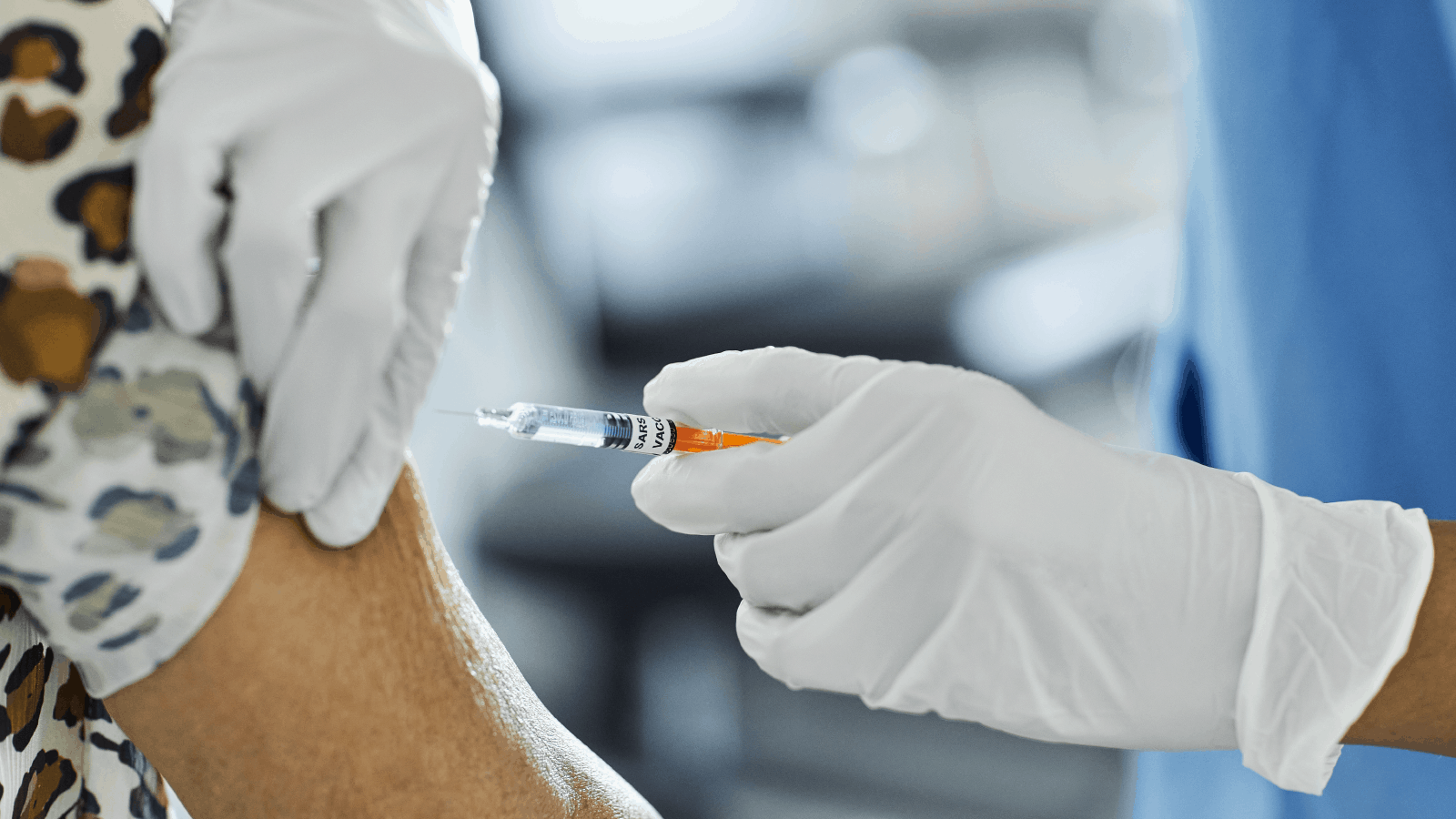
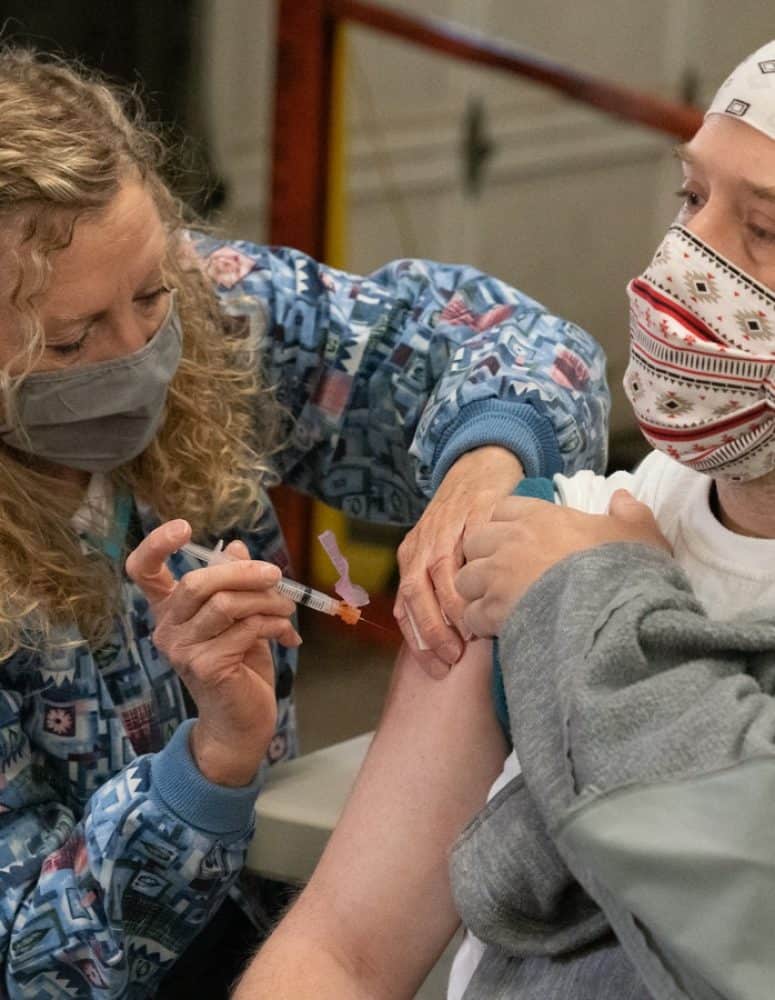
As the U.S. vaccine rollout expands to nearly all adults, manufacturers are figuring out how to encourage workers to be vaccinated. To help them, the NAM and The Manufacturing Institute are providing resources and advice through their This Is Our Shot project. Most recently, the project hosted a webinar to help employers frame conversations about vaccines, called Employer COVID-19 Vaccine Communications: Do’s and Don’ts. Here are some of the highlights.
The participants: The webinar was hosted by NAM Vice President of Brand Strategy Chrys Kefalas, the NAM lead of the This Is Our Shot project. It featured Ann Searight Christiano, director of the Center for Public Interest Communications at the University of Florida, and Jack Barry, a postdoctoral research associate for the University of Florida’s Center for Public Interest Communications.
Why communication matters: “The vaccines are becoming widely available and so people are really at a point where they no longer have to wait. It’s time,” said Christiano. “But as employers, you have a great deal of influence and trust with your employees and are well positioned to help build their trust and encourage them to get those vaccines.”
What to think about when you talk about vaccines: According to Christiano and Barry, there are eight factors to think about when developing vaccine communications: worldviews, timing, messengers, narratives, relationships, social norms, emotions and motivations. Christiano and Barry recommend taking people as they are—and responding to their particular identities and values.
Think about who and when: The timing and the messengers are extremely important. National health professionals are far more trusted on pandemic advice than celebrities, for example. People generally want messengers from their own communities, too. Think of the “influencers” in your workplaces—the respected leaders, the trusted employees—and consider using them in your campaigns, say Christiano and Barry.
The message itself: Use specifics to show how important it is to get vaccinated, such as that vaccines allow you to travel or hug your grandparents. And use the themes of choice, regret and control—often cited by vaccine hesitators—and frame them in a positive way to increase vaccine uptake.
Things to avoid: Don’t amplify people’s concerns and avoid appeals to unpleasant emotions like shame and fear, the researchers advise. Consider instead using pleasant emotions like pride, joy and parental love. Consider the motivations of the messenger, too. Be transparent and honest about why you want people to get vaccinated.
The last word: “Our role is to help all manufacturers get fact- and science-based information to safeguard workplaces and communities and to help end this pandemic. We’ll continue hosting webinars, curating the most effective tools available and deploying other research-proven resources at NAM.org/ThisIsOurShot,” says Kefalas.
For more details on how to create communications for your employees, check out the whole presentation here.
Related
How 5G Is Transforming Manufacturing
Get the Latest News
Sign up here
More than half of all manufacturers will be testing or using fifth-generation cellular wireless technology (aka 5G) in some capacity by the end of 2021, according to a new study from The Manufacturing Institute. The big numbers:
- 91% of manufacturers believe 5G connectivity will be important to the overall future of their businesses.
- 91% of manufacturers indicate speed of 5G deployment will have a positive impact on their ability to compete globally.
- 88% of manufacturers indicate 5G connectivity will allow engineers to troubleshoot remotely.
All-encompassing: 5G is poised to help manufacturers in almost every part of their businesses, according to the study.
- Nine in ten manufacturers expect the utilization of 5G to lead to the creation of new processes (88%) and new businesses (86%). It can make supply chains more efficient and both machines and workers more productive. It also will likely lead to new improvements no one has anticipated yet.
Drilling down: Let’s look at just one facet of 5G’s potential impact: its effects on factory operations. This is how comprehensive the 5G transformation is expected to be:
- Four-fifths of manufacturers indicate 5G technology will be important to inventory tracking (83%), facility security (81%) and warehousing and logistics (81%) within their facilities.
- Three-fourths of manufacturers indicate 5G will also be important to inspection (76%) and assembly (76%) activities, with seven in ten saying packaging (72%) and employee training (71%) efforts will benefit from the deployment of 5G.
And let’s not overlook the fact that more than 90% of manufacturers expect cost savings of approximately 38% from their 5G connections.
Competitive advantage: “Manufacturers’ competitiveness depends on their ability to continuously improve the efficiency and effectiveness of their operations, and disruptive technologies are changing the way that firms innovate and produce,” said the Institute’s Center for Manufacturing Research Director and NAM Chief Economist Chad Moutray.
More information: You can join the Institute for a webinar on 5G technologies on Tuesday, April 6, at 2:00 p.m. ET. Register here.
Related


Why a Navy Machinist Chose a Manufacturing Career
Get the Latest News
Sign up here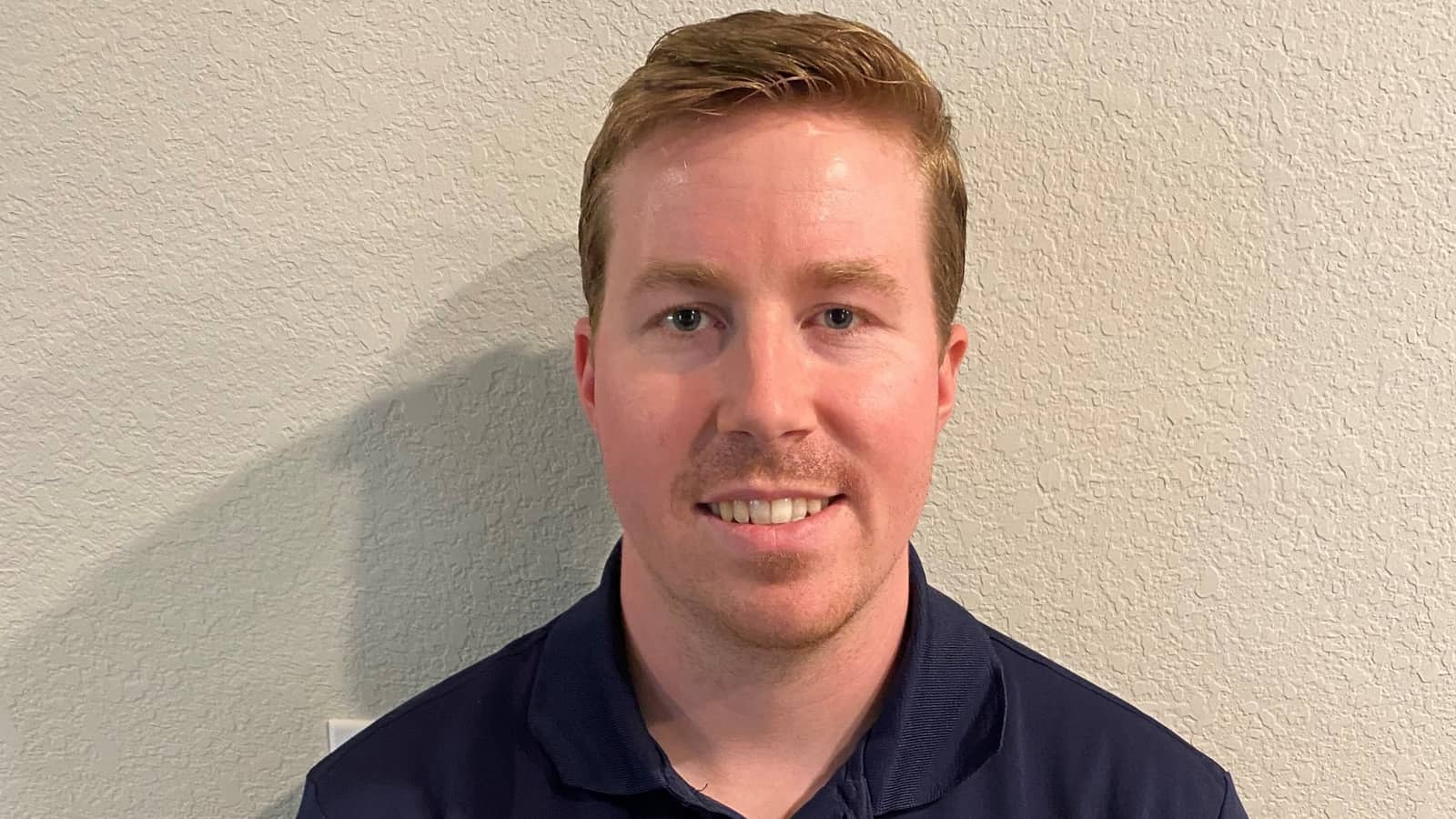
Derek Read always knew he wanted to join the Navy, and he enlisted after high school—rising to become a machinist’s mate responsible for maintaining, repairing and running the ship’s engine as well as corresponding machines and equipment. However, when it came time to find his next career nine years later, he wasn’t sure what to do—until his research turned up the The Manufacturing Institute’s Heroes MAKE America program, which helped Read translate the skills he already had into a modern manufacturing setting.
- “It’s definitely been enlightening,” said Read. “For the most part, I had the mechanical background and most of the skills, but HMA bridged the gap and gave me some technical expertise, as well as the extensive knowledge and certifications needed to get hired by a manufacturing company. Overall, it’s been an amazingly positive experience.”
One-on-one: Some of Read’s most valuable experiences were his meetings with executives and hiring officers at different manufacturing companies.
- “One of the greatest things they’ve given us is facetime with manufacturing company VPs, HR representatives and recruiters,” said Read. “They allowed us to get a better understanding of what was out there and what companies were looking for. Facetime like that is hard to come by unless you’re doing a specialized program like this, and it’s worth a lot.”
What’s next: Today, Read is fielding a few different job interviews, which he received via LinkedIn after Heroes helped him create his profile on the site. “Without HMA, I probably wouldn’t have been approached by those companies,” said Read.
Paying it forward: When asked what advice he’d give to other transitioning servicemembers considering the Heroes program, Read didn’t hesitate. “That’s easy—you’d be crazy not to take advantage of an amazing opportunity like this,” said Read. “The HMA program is outstanding. Take advantage of programs like this one, and don’t wait. Different manufacturing companies have a vast array of jobs. There’s definitely a job out there for you.”
From a distance: What makes Read’s enthusiasm all the more compelling is that he experienced the entire program remotely. But with the help of some virtual reality tools, he was able to participate without missing a step.
- “The VR goggles—that was amazing,” said Read. “I’ve never played with VR before. It’s almost like a video game. The training and tool seminars—I got to play with different tools and interact with the VR, doing measurements, calibrating equipment and going over parts of the manufacturing facility. It was a lot of fun to play with.”
That kind of substantive learning in an engaging environment is what the Caterpillar Foundation will bring to more heroes in the coming years, thanks to its new $2.25 million donation designed to help Heroes MAKE America increase its integration of virtual reality technology and expand training opportunities for the military community.
The last word: As Caterpillar Chairman and CEO Jim Umpleby said when the partnership was announced, “Caterpillar is proud of the support provided to veterans and their families through the Caterpillar Foundation’s donation to the Heroes MAKE America program. I am pleased the Foundation can help make this world-class skills training program available to all members of the global military community and connect them to careers in manufacturing.”
Related

NAM and MI Launch Yellow and Red Ribbon Initiative
Get the Latest News
Sign up here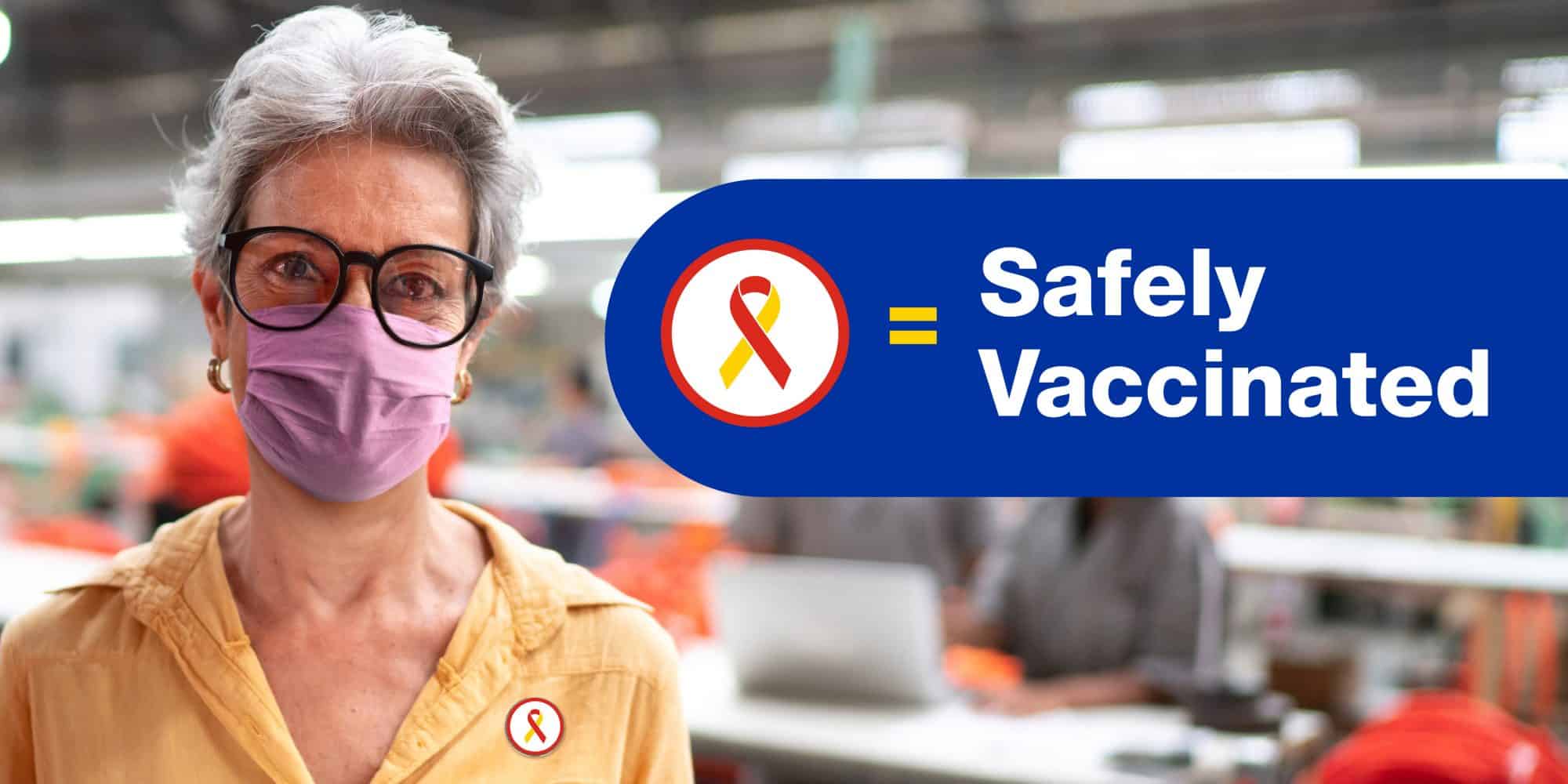
The NAM and The Manufacturing Institute are launching the Yellow and Red Ribbon Initiative today to encourage vaccinations against COVID-19. Here’s what you need to know to get involved.
What it means: The ribbon is designed with two colors: yellow, which shows that we support one another, and red, which signifies that we care for one another. Wearing or displaying yellow and red ribbons is intended to serve as a sign of support for COVID-19 vaccination and a signal that you have been personally vaccinated.
Why do it: “It’s the same philosophy behind ‘I Voted’ stickers,” said NAM President and CEO Jay Timmons. “Seeing that others have been safely vaccinated sends a powerful message to those who have not yet made the decision to get their shot.”
What you can do: You can wear the ribbon to work or out in public, or in your social media profile pictures. If you’re an employer or run a vaccination site, you can make the ribbons available to those who get their shot.
How to get your pins: The NAM and the MI are producing yellow and red pins to distribute to workers, families and communities and have developed tools such as bilingual social media, email and newsletter copy and posters to support distribution.
- Bulk orders can be made online here. The NAM and MI are also encouraging a grassroots effort in communities nationwide, urging people to make ribbons at home, find them online or locate them at a craft store.
What we’re building on: Getting manufacturers and Americans their COVID-19 vaccines is a key step toward ending the pandemic. See how the NAM and MI are working to get that done through its “This Is Our Shot” project.
Related
A Hero Gets a Shot at Manufacturing
Get the Latest News
Sign up here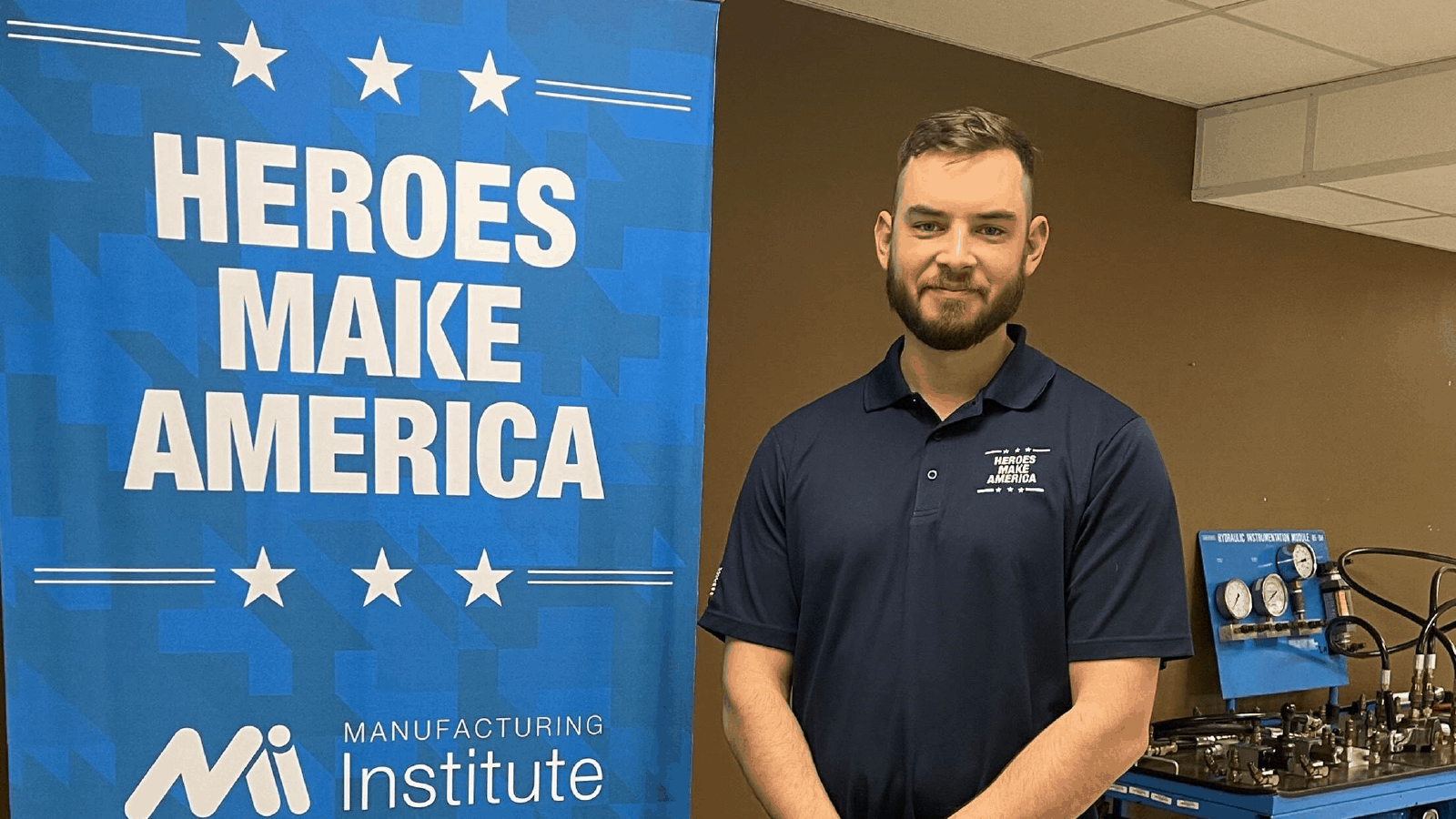
Zachary Willis has transitioned out of the military twice—and the second time, The Manufacturing Institute’s Heroes MAKE America program made all the difference.
A passion for service: Willis had wanted to join the Marine Corps his entire life and felt even more strongly about it after 9/11. A little less than a year after he graduated high school, he did so. “I wanted to serve my country, and my country needed me,” he told us.
Two exits: Willis spent four years in the Marine Corps on active duty, with two deployments as an infantryman. He spent the next four years in the reserves, then left the military for a short stint in the civilian world. But feeling adrift, he ended up joining the U.S. Army as a mechanic in 2017.
When health issues led him to transition out of the military a second time, he knew he needed a strategy for what would come next. The Heroes MAKE America program, which helps members of the military community find opportunities in manufacturing, sounded like a great fit.
- “Getting out this time around was so different from the first time,” said Willis. “The first time I didn’t really have a plan. This time I was a lot more mature. I was like, I need to make sure there is something out there—and Heroes MAKE America seemed like a great opportunity to get into an industry with a lot of growth potential.”
A different world: Heroes exposed Willis to a world of modern manufacturing that was well beyond what he had expected.
- “I always thought manufacturing was just a bunch of guys on an assembly line who put things together for 30 years and then retired,” said Willis. “But then I got into this program, and I saw how innovative it is. It’s constantly seeking improvement. It’s so different from the manufacturing of my father’s or grandfather’s generation.”
An expanded network: Willis is enthusiastic about his experience in the Heroes program—both in terms of the skills training and the opportunities to explore career options.
- “It’s been amazing,” said Willis. “The ability to reach out and connect with other employers all around the country—from smaller companies to huge international corporations. You don’t see that in very many places. I wish more people took advantage of programs like this.”
What’s next: Willis graduated from the program in early March and received four different job offers. He’ll start a new role soon manufacturing gunpowder at Hodgdon Powder Company near his home in Kansas. In fact, he’s so enthusiastic about the Heroes MAKE America program that he’s already encouraging his new employer to get involved.
- “The company isn’t even a part of the program, and when I told them about it, they said, huh, we gotta look into that,” said Willis. “It’s something more companies should get on board with.”
Heroes gets a boost: Willis also got to take on a new challenge during his program: using virtual reality technology to supplement his instructor-led hands-on learning. The technology let him learn everything from how to put on personal protective equipment correctly in a manufacturing environment to how to use welders, micrometers and digital calipers.
And as it happens, even more Heroes students will be able to engage virtually in the coming years. Thanks to a new $2.25 million donation from the Caterpillar Foundation, the Heroes program will be able to increase its integration of virtual reality technology and expand training opportunities for the military community.
The last word: “Caterpillar is proud of the support provided to veterans and their families through the Caterpillar Foundation’s donation to the Heroes MAKE America program,” said Caterpillar Chairman and CEO Jim Umpleby. “I am pleased the Foundation can help make this world-class skills training program available to all members of the global military community and connect them to careers in manufacturing.”
Related
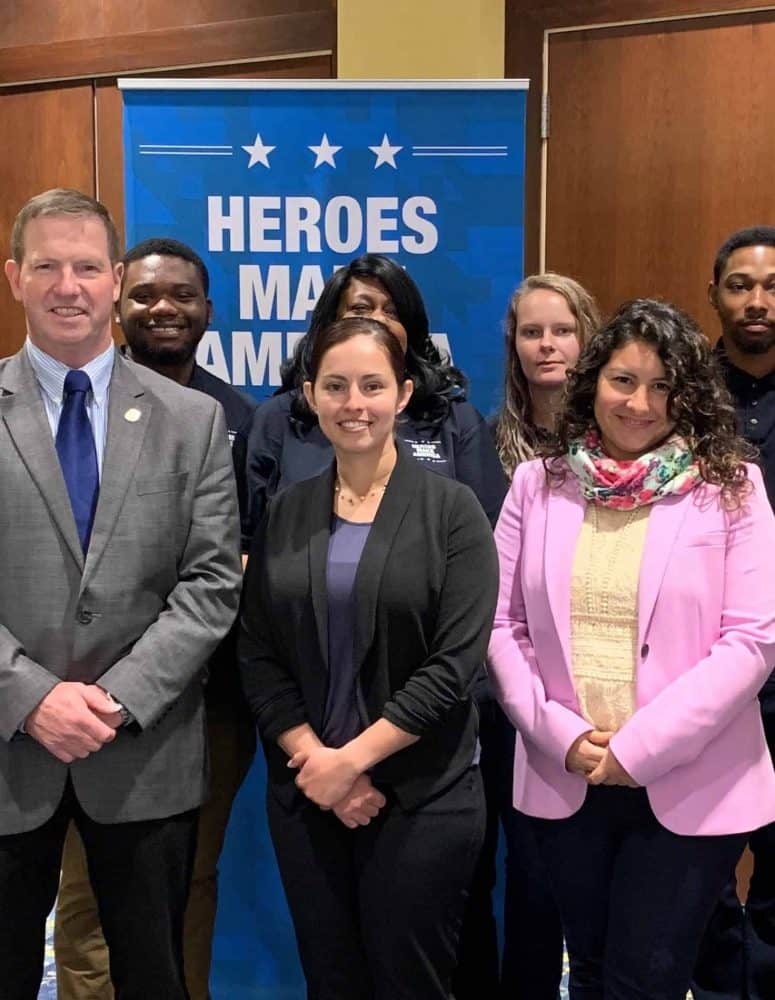
Manufacturing Institute Partnership Enhances Railroad’s Hiring Reach
Get the Latest News
Sign up here
Union Pacific is seeking a more diverse workforce as it strives to continue “building America,” as it says. To do so, it is partnering with The Manufacturing Institute, the NAM’s workforce development and education partner, on a $3 million three-year joint initiative. Beth Whited, who serves as executive vice president and chief human resource officer at Union Pacific, recently told us more about these ambitious plans.
The details: The initiative, called Careers on Track, will work to inspire more women and youth to pursue modern industry careers. The funding supports workforce development and career solutions that will include:
- A new digital STEM curriculum;
- A virtual STEM experience—in which participants can “choose their own adventure” while exploring interactive 3D models of a real facility, locomotive and more;
- A STEM micro-grant program for young people; and
- A digital campaign showcasing industry career opportunities for underserved women in select regions.
Ultimately, Union Pacific intends to double the number of women in the UP workforce within the next 10 years.
Why partnerships matter: “These types of partnerships are important for us because they broaden our reach,” says Whited. “We run pilot programs of our own, but it’s difficult for us to make those available in every school in our served territory. With the MI’s broad reach and established programs, we can reach more women and youth than we could on our own.”
The scope: Whited likes to remind people that nearly everything in their homes moves by rail at some point, whether as a raw material or as a finished product. That also means there is a wide range of jobs involved, from skilled roles in transportation and manufacturing to civil, electrical and computer engineering—jobs that involve designing more fuel-efficient locomotives or building the freight cars of the future.
The tech: “People who don’t know much about railroads are always surprised by the level of high tech that’s employed,” says Whited. “Railroads have been around for 160 years plus, and so people think about it as old technology, but it absolutely isn’t.
- “You’ve got unbelievable signaling systems run everything safely, next-level optimization tools that determine how and when trains run, sophisticated technology in the 4,500 horsepower locomotives that we use to haul freight and so much more. The level of tech and advanced analytics and machine technology is usually quite startling to people.”
The pitch: Whited has advice for women who are unsure about working in a traditionally male-dominated field. “I would tell people to challenge their own thinking,” says Whited. “There aren’t jobs that are for men and jobs that are for women; there are jobs—and these are great jobs with great benefits that will help you fulfill your goals and give you a sense of pride. Come try it.”
The last word: As MI Executive Director Carolyn Lee said about this partnership, “There are nearly 500,000 job openings right now in manufacturing and millions more expected over the next decade. Closing the gender gap and building awareness with young people are critical to meeting this incredible need.”
Related


The Story Behind “This Is Our Shot”
Get the Latest News
Sign up here
The NAM and The Manufacturing Institute have launched a large-scale project to promote vaccination among manufacturing workers and communities, called “This Is Our Shot.”
As NAM President and CEO Jay Timmons describes it, “This project builds on our months of work advocating the use of face masks and other smart health measures to protect all Americans . . . . Now is our opportunity as a country to end this pandemic. Our future depends on all of us rolling up our sleeves and getting armed against COVID-19.”
So how did they make it happen? We recently talked to NAM Vice President of Brand Strategy Chrys Kefalas about the inside story.
Why: As Kefalas puts it, “We have a crisis. Depending on which study you look at, between 30% to 40% of Americans say they will not get a COVID-19 vaccine. We have to take direct aim now at vaccine hesitancy; otherwise, we’ll have safe and effective vaccines and not enough people willing to get them to reach heard immunity.”
Why the NAM and the MI? The NAM, along with its workforce development and education partner, the MI, has a “singular power” to leverage manufacturing’s unifying position as a trusted community resource, Kefalas explains.
How: In the spirit of manufacturers everywhere, let’s take a look at how this project got made.
- First, the research: “We’ve relied on a wide range of suggestions and guidance, from manufacturers of all sizes and all sectors. We’ve also sought recommendations from the Gates Foundation, the CDC and other public health leaders,” says Kefalas.
- Second, the reach: “We’re engaging company medical officers, local health care providers and community members who can change hearts and minds about COVID-19 vaccination.”
- Third, the sights: “It’s going to take videos, photos, flyers, posters, emails—and other very visible signs that others are getting armed against COVID-19.”
- Fourth, the psychology: Research shows that a sense of group loyalty or patriotism can boost vaccination numbers, Kefalas explains. To create that sense of solidarity (and social influence), the NAM and MI will distribute red and yellow ribbon pins for those who get vaccinated—and encourage people to put up red and yellow ribbons outside their homes once their whole households have received the vaccine.
What can you do? The initiative is providing manufacturers with communications materials to share with their teams. As Kefalas says, clear, consistent and direct communication from employers and peers really helps. “And when you are conveying medical information, rely on the experts like medical officers and direct people to their medical providers,” Kefalas suggests.
All we need is love: In case you missed it, the first video in this initiative dropped yesterday, a charming short called “I Love Frank.” Kefalas explains the idea: “Caring for others is really the one message that seemed to resonate across all demographic groups. Vaccinations should be really simple, because it comes down to one thing: we want to protect the people we love.” You can’t say it any better than that.
Related
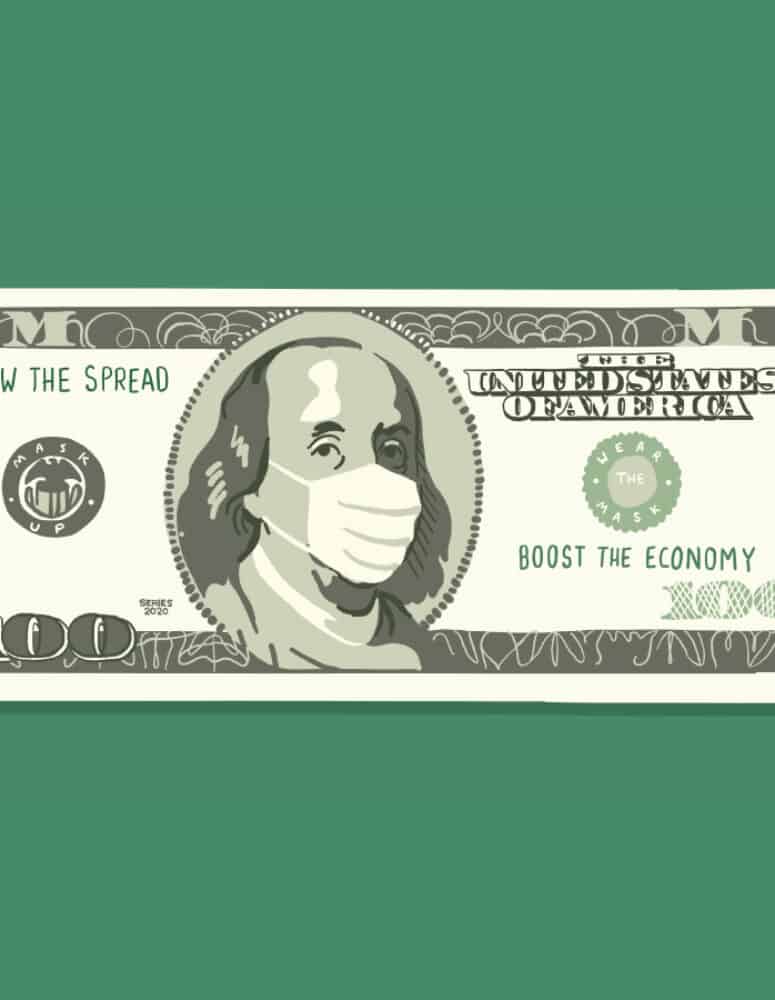
As COVID-19 Infections Hit 100 Million People Worldwide, Manufacturers Launch Counterassault
“This Is Our Shot” Seeks to Boost COVID-19 Vaccine Acceptance
Washington, D.C. – As worldwide cases of COVID-19 reached a sobering new milestone of 100 million people, the National Association of Manufacturers and The Manufacturing Institute—the workforce development and education partner of the NAM—are launching a new project taking direct aim at vaccine hesitancy and stopping the virus in its tracks by convincing more Americans to prepare to receive the COVID-19 vaccine. This project follows the NAM’s nearly year-long campaign imploring Americans to follow CDC guidelines, such as wearing a mask and social distancing.
The project, called “This Is Our Shot,” seeks to boost COVID-19 vaccine acceptance among manufacturing team members, their families and their communities through a multifaceted national campaign. With another grave milestone breached and the virus mutating, the country’s response and recovery is depending on manufacturing workers more than ever.
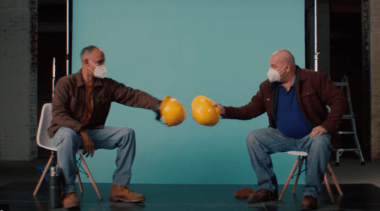
As part of the launch, the NAM released “I Love Frank,” a public service announcement highlighting why manufacturers are rolling up their sleeves to get a COVID-19 vaccine: to protect their family, coworkers and the people they love. The PSA will run across various social media and digital platforms and is the first in a series that will be released in 2021.
“One hundred million people have now been impacted by this horrible disease. Asking all Americans to roll up their sleeves and get vaccinated against COVID-19 is a pivotal step toward stopping this upward trend, putting millions of people back to work and eradicating this virus. That’s why today the National Association of Manufacturers and The Manufacturing Institute launched ‘This is Our Shot,’ to get more people armed against COVID-19 and to protect the people we care about,” said NAM President and CEO Jay Timmons.
“This project builds on our months of work advocating the use of face masks and other smart health measures to protect all Americans as we continue to share our insights with the Biden administration and state officials to help defeat COVID-19. Now is our opportunity as a country to end this pandemic. Our future depends on all of us rolling up our sleeves and getting armed against COVID-19.”
Background:
The project, live at NAM.org/ThisIsOurShot, includes six main components: (1) science-based messaging research; (2) emergency industry convening and education, such as webinars; (3) an online vaccine information hub; (4) a PSA campaign; (5) a Yellow and Red Ribbon initiative (for vaccinated individuals to show their peers they’re a part of the fight); and (6) a rapid response media and digital campaign. Resources available at NAM.org/ThisIsOurShot will be updated regularly, providing the latest information and tools for vaccine outreach and access.
-NAM-
The National Association of Manufacturers is the largest manufacturing association in the United States, representing small and large manufacturers in every industrial sector and in all 50 states. Manufacturing employs more than 12.3 million men and women, contributes $2.32 trillion to the U.S. economy annually and has the largest economic multiplier of any major sector and accounts for 63% of private-sector research and development. The NAM is the powerful voice of the manufacturing community and the leading advocate for a policy agenda that helps manufacturers compete in the global economy and create jobs across the United States. For more information about the NAM or to follow us on Twitter and Facebook, please visit www.nam.org.